
When Action Becomes Your Enemy
In 2007, a study of 286 penalty kicks in professional soccer matches revealed a fascinating glitch in human logic. Goalkeepers almost always dove left or right, despite the fact that the ball went down the centre 28% of the time. The numbers suggest that the goalkeepers may be diving more out of instinct or habit than strategy.
So why did they dive? Because standing still feels like doing nothing. Diving, even in the wrong direction, looks like effort.
This is what psychologists call Action Bias: the impulse to act when faced with uncertainty, even if that action is counterproductive.
And right now, this might be exactly what’s happening in your business.
You’ve launched multiple marketing strategies, tweaked your offer, and you’re working twice as hard as you did years ago. Yet somehow, your effort isn’t translating into results, and your business isn’t growing despite all the hard work. Then, when you ask for help, you get the same generic advice:
“Just do it. Stop overthinking. You’ll figure it out as you go along.”
But you’ve been “just doing it” for months with nothing to show for it.
If it feels like nothing you try works or you can’t make the right business decisions anymore, you’re not alone. The truth is that sooner or later, every business reaches this point. It’s unavoidable. The only real difference between failure and success is how quickly you recognize it and shift gears to start seeing your business clearly again.
Why Decision-Making Was Easy Before
Most small businesses start by exploring an idea: turning a skill, hobby, or interest into something viable. They perform market research and collect information to learn about their customers, competitors, and the market gap they can uniquely fill. Ideally, they keep gathering information until:
They stop learning something new, and any additional information just confirms what they already know
The next action becomes obvious and clear
That next action looks different for different businesses. For some, it’s building a website or prototype to test with potential customers. For others, it might be using available funds to rent business premises.
Regardless of the specific step, the underlying principle is the same: they’ve wrapped their heads around the available data and developed what’s known as conceptual knowledge.
This is when “Just Do It” advice becomes hugely beneficial. Many aspiring business owners never take that first step due to nerves, self-doubt, or negative past experiences. In doing so, they rob themselves of the second type of knowledge: experiential knowledge, the learning that comes only from doing.
Those who do take that leap learn things they never could have learned from books or research alone. They start moving back and forth between thinking and doing. They refine their understanding, test it in the real world, learn from what happens, then refine again. Over time, thinking and doing become so intertwined that they stop noticing where one ends and the other begins.
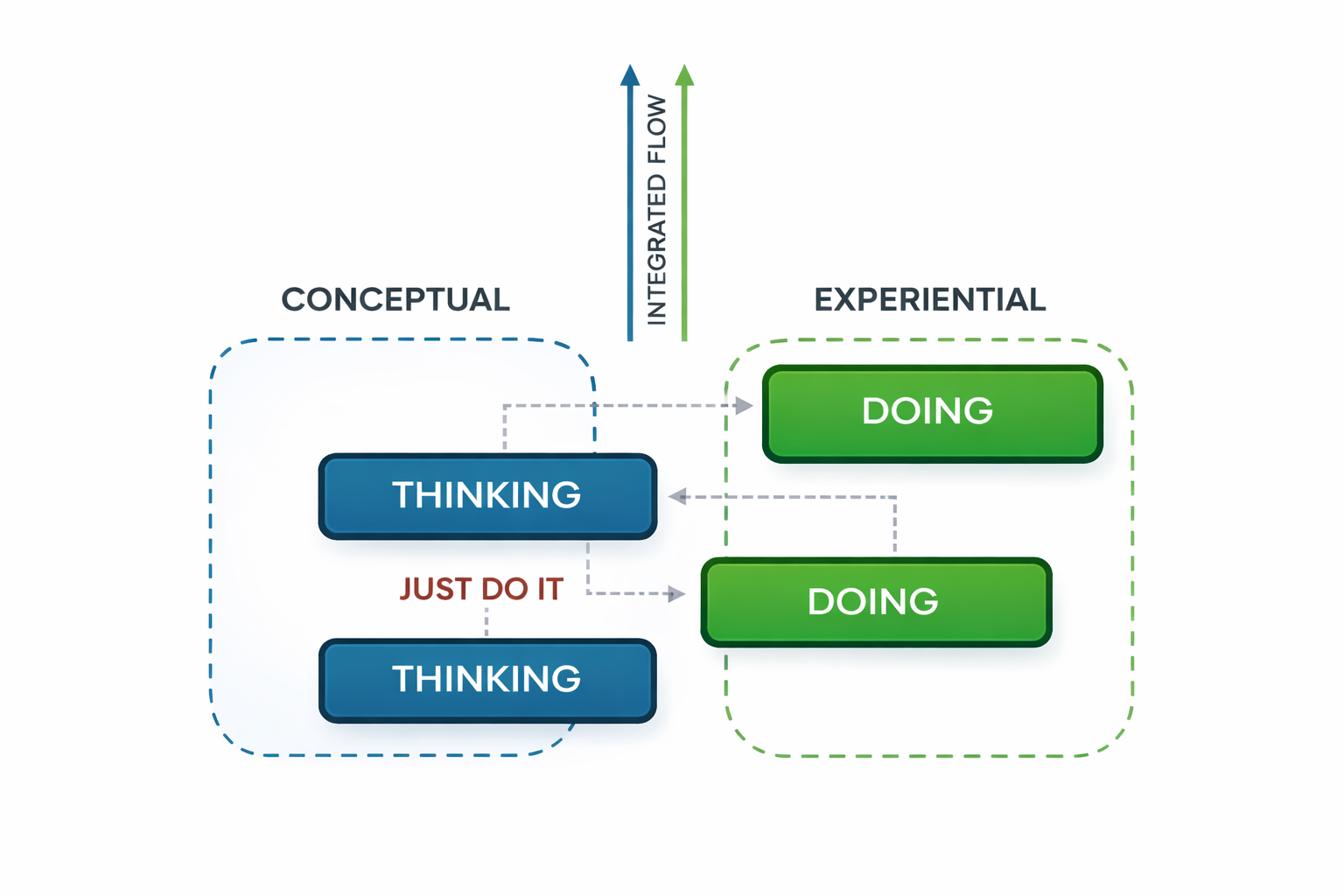
While starting and running a business is hard, at this stage of integrated flow, where conceptual and experiential knowledge work seamlessly together, decision-making and problem-solving feel easy. Why? Because there’s a deep understanding of the ecosystem and landscape within which the business operates. By leveraging multiple sources of knowledge, businesses are built on strong foundations and set up for success.
However, as I mentioned earlier, this never lasts forever.
What Has Changed
Some businesses arrive here sooner, some later, but the universal truth is this: every business reaches the point when business growth gets stuck, when decisions and actions that worked before no longer make sense, and working hard stops getting results.
Of course, the business landscape has always changed. Markets shift, competitors emerge, trends come and go. But until now, those changes were incremental enough that your integrated knowledge could adapt naturally. You learned as you went, adjusted your approach, and kept moving forward.
What we’re experiencing now is different. This isn’t evolution, it’s revolution.
The driver? A fundamental shift in the ecosystem and landscape within which businesses operate.
How The Landscape Has Shifted
With rapidly evolving technology, regulatory frameworks, and customer expectations, the business environment has become increasingly complex and difficult to navigate.
In the last decade, technological change has reshaped the business landscape in ways that were unimaginable in 2015. Digital technologies like artificial intelligence, big data analytics, cloud computing, and automation are now integral to how companies operate, innovate, and compete, transforming internal processes, market dynamics, and decision-making frameworks across industries. Recent trend reports highlight how these technologies aren’t just optional but central to future competitiveness, with AI and data platforms projected to be among the most impactful drivers of strategic advantage in 2026 and beyond.
At the same time, customer behaviour has undergone its own seismic shift. What customers expect, how they research, where they buy, and why they choose one business over another has fundamentally changed. The customer journey that worked five years ago, with clear touchpoints and predictable decision-making patterns, has been replaced by fragmented, non-linear paths influenced by social proof, peer recommendations, and instant information access. Customers now expect personalized experiences, immediate responses, and seamless interactions across multiple channels. The old playbook of consistent messaging and patient nurturing often no longer matches how your customers actually make decisions. This is often why your marketing isn’t working anymore.
This environment has fundamentally altered the ease with which business leaders once made decisions. Traditional patterns, such as incremental growth, long product lifecycles, or stable competitive dynamics, have been replaced by rapid innovation cycles, real-time customer expectations, and new regulatory and ethical demands around data, privacy, and digital accountability. Even within the European Union, for example, more than 70 new laws under the Green Deal alone (between 2019 and 2024) have imposed complex compliance requirements on companies, increasing administrative burdens and uncertainty.
We’ve Seen This Before
History shows that when external conditions change dramatically, even dominant companies can struggle to survive.
Consider WeWork, once valued at $47 billion in 2019 with visions of revolutionizing office space. The company aggressively expanded by signing long-term leases while relying on short-term tenants, a model that collapsed when economic conditions shifted. By 2023, WeWork filed for bankruptcy, brought down not by lack of effort but by doubling down on a flawed strategy without pausing to reassess the fundamentals. Or take Quibi, the mobile streaming service that launched in 2020 with $1.75 billion in funding and Hollywood backing. Despite premium content and technological innovation, the company shut down within six months because it built an entire business model around a customer behaviour pattern, watching shows during commutes, without validating whether people actually wanted to pay for that experience. The company didn’t fail from lack of action; it failed because all that action was built on unexamined assumptions about a market that had already moved on.
These historical precedents illustrate that large shifts in technology and customer behaviour are not new. But the speed and pervasiveness of change today create an even more complex decision-making environment than in previous decades.
The Cost of Action Without Clear Direction
When businesses hit this “fog” and respond by doing more (more campaigns, more pivots, more tools, more offers) without slowing down to re-understand the landscape, the consequences are rarely neutral. This is when you end up working hard but not getting the results you need. You are busy all the time, yet your business growth remains stagnant, and problems seem to reappear no matter what you try.
One of the most common outcomes is symptom-fixing. Businesses patch what’s visibly broken (conversion rates, engagement, sales) without identifying root causes of the underlying problems (shifting customer expectations, a changed buying journey, new competitors, pricing pressure, trust erosion). The same problems keep resurfacing at greater cost.
At the strategic level, this constant motion can push companies into the success trap, where they keep doubling down on what used to work instead of exploring what the new environment requires. And because action without clear direction creates misalignment across the business, the financial cost can be severe.
Industry analysis on strategy execution suggests poor execution can cost organizations up to 10% of annual revenue, while roughly 67% of strategic initiatives fail, most commonly due to execution breakdowns and lack of alignment, not because the strategy itself was inherently wrong.
What Differentiates Failure from Success
The key difference between businesses that overcome this point in their business journey and those that fail often lies in how they respond to change, rather than how much action they take. When your business isn’t growing despite hard work, the instinct is to do more. But more action without clear direction is exactly what keeps you stuck.
Companies that cling to outdated strategies or chase quick fixes without re-evaluating the surrounding landscape and ecosystem of their business remain stuck in that success trap, over-investing in existing practices that once worked and neglecting the exploration of new opportunities.
For example, research by Boston Consulting Group in 2025 found that only about 5% of companies are actually deriving meaningful value from their investments in AI, even though many are pouring significant resources into the technology. This is a clear example of how the majority of businesses make investments without rethinking their strategic approach, yielding little benefit despite substantial effort and cost. On the other hand, “AI-mature” organizations typically succeed because they adopt a long-term strategy, embed AI deeply into business operations, and cultivate an environment where learning and experimentation are part of how they make decisions, not just isolated initiatives.
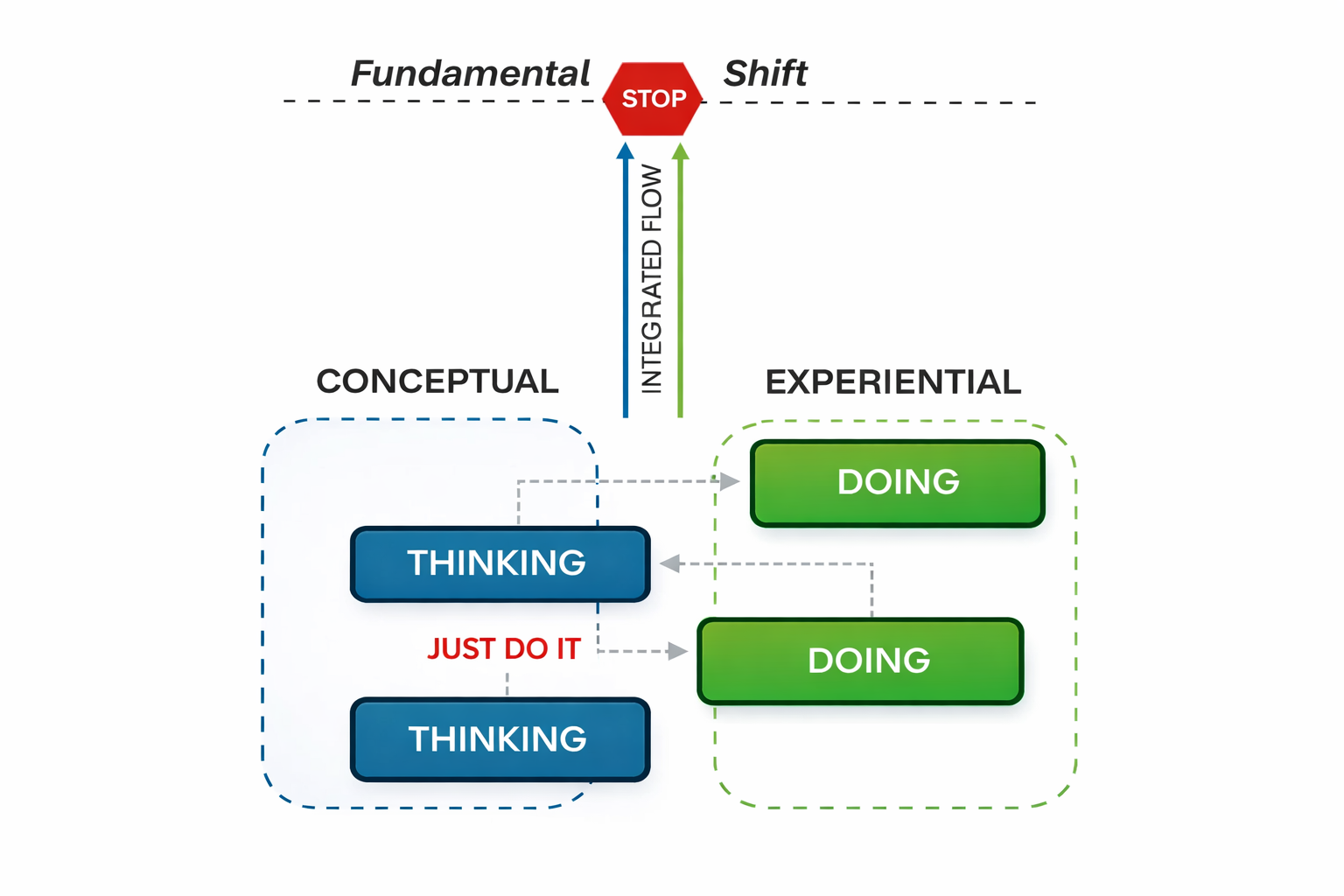
This highlights a broader truth: success in today’s business environment is less about how much you do and more about how intelligently you adapt by deepening your understanding of the changing landscape and aligning your decisions with that insight.
The Seductive Logic of Movement
But if we can see from real-world examples how damaging this is, why do many businesses refuse to slow down and keep jumping from solution to solution until they have nothing left to give?
The truth is simple: they don’t know anything else. They’ve been in this state of constant action-taking for so long that they don’t remember when learning and doing were two separate things.
Remember those goalkeepers diving left and right? For the successful entrepreneur who has hit a wall, Action Bias is the siren song that leads to burnout. You feel the pressure to “Just Do It,” hoping something will somehow work, but when the landscape has shifted, your frantic movement is just a high-speed dive in the wrong direction.
So What Does This Mean for Your Business?
The business world loves action-takers. Study after study celebrates the doers over the thinkers. Research consistently shows that successful entrepreneurs treat their experiences, both successes and failures, as data points to be utilized and built upon, learning through trial and error rather than endless planning. Companies like Amazon have even codified this into their culture with their famous “bias for action” leadership principle.
But when your business growth is stuck and nothing you try seems to work, blindly following this “bias for action” principle can actually make things worse. Here’s where the narrative becomes dangerous.
Somewhere between “don’t overthink it” and “just execute,” we’ve conflated movement with progress. However, they are fundamentally different things.
Movement is changing your pricing three times in six months.
Progress is understanding why your original pricing didn’t resonate and finding the right pricing strategy based on that insight.
Movement is trying four different marketing channels because “you have to be everywhere.”
Progress is knowing which one channel your specific customers actually use.
Movement is action without direction. When your business isn’t growing despite hard work and when that internal compass you once relied on has stopped working, aimless action doesn’t lead you out of this “fog”. It just exhausts your resources faster.
The question isn’t whether you should act. It’s whether you understand the landscape and ecosystem of your business well enough to know which action will actually move you forward.
